Laparoscopic Appendectomy
- incisionary
- Dec 24, 2025
- 2 min read

Laparoscopic appendectomy is a minimally invasive surgical procedure used to treat appendicitis. Appendicitis is the inflammation of the appendix.
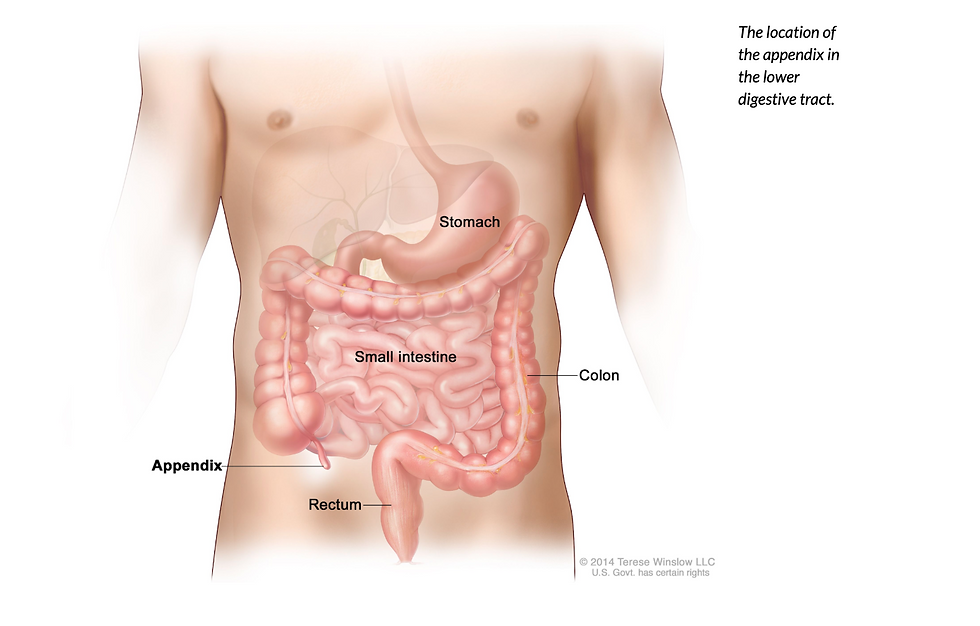
The Appendix
The appendix is a small, finger-like sac that sticks out from the cecum which is the first part of the colon close to the end of the small intestine. Although it was regarded as a vestigial organ with no purpose in the past, recent research suggests that the appendix is home to many bacteria that play a role in the immune system of the gut.
Appendicitis
Appendicitis occurs when the appendix becomes inflamed and infected, usually due to a blockage inside it. This causes swelling, pain, and reduced blood supply. If untreated, the appendix may rupture, leading to serious infection. Appendicitis is regarded as a medical emergency and thus requires immediate treatment.
Treating Appendicitis
There are two main surgical methods used to remove the appendix: open appendectomy and laparoscopic appendectomy.
In an open appendectomy, a single incision measuring about 2 to 4 inches is made in the lower right side of the abdomen, through which the appendix is removed.
In contrast, laparoscopic appendectomy is less invasive and involves making one to three small incisions. A laparoscope, which is a thin tube with a camera and surgical instruments, is inserted to allow the surgeon to view the area and remove the appendix with precision.

The choice of procedure also depends on the patient’s condition. During laparoscopic surgery, the surgeon may switch to an open appendectomy if problems start to appear. In cases where the appendix has ruptured, infection has spread, or an abscess has formed, it may be safer to take the open approach. Sometimes, antibiotics and the drainage of any abscess are required before surgery. Although antibiotics alone have shown as a viable treatment for appendicitis, appendectomy remains the standard treatment because medication does not always fully resolve the condition.
Evaluation of Laparoscopic Appendectomy
Laparoscopic appendectomy provides many advantages over the open approach, including less pain after the surgery, smaller scars and faster recovery. Although it isn’t always suitable, for example in situations of infection or rupture, its overall benefits outweigh its limitations. As a result, it is widely recognized as the most effective treatment for appendicitis when clinically appropriate.
by Aniket Kumar Sinha at Incisionary
APA References
UPMC. (2020). Laparoscopic Appendectomy. Children’s Hospital of Pittsburgh. https://www.chp.edu/our-services/surgery-pediatric/patient-procedures/laparoscopic-appendectomy
https://www.cancer.gov/publications/dictionaries/cancer-terms/def/appendix. (2011, February 2). Www.cancer.gov. https://www.cancer.gov/publications/dictionaries/cancer-terms/def/appendix
Bandoim, L. (2023, February 5). What Does the Appendix Do? Theories, Location, and Size. Verywell Health. https://www.verywellhealth.com/what-does-the-appendix-do-5270731
John Hopkins Medicine. (2024). Appendectomy. John Hopkins Medicine. https://www.hopkinsmedicine.org/health/treatment-tests-and-therapies/appendectomy
Johns Hopkins Medicine. (2025). Appendicitis. Johns Hopkins Medicine. https://www.hopkinsmedicine.org/health/conditions-and-diseases/appendicitis
Laparoscopic Appendectomy in Dwarka | Dr. Ashish Pitale. (2024). Laparoscopicsurgeon.co.in. https://www.laparoscopicsurgeon.co.in/laparoscopic-appendectomy


Comments